
API Guide
Overview of Operations
The following endpoints represent the core payment lifecycle operations.
| Operation | Endpoint | Method | Description |
|---|---|---|---|
| Create Checkout Session | /v1/session/payment/create | POST | Creates a checkout session. |
| Create MIT Checkout Session | /v1/session/payment/create-mit | POST | Creates a checkout session for the initial standing instruction for subsequent recurring payments |
| Authorize Payment | /v1/session/payment/authorize | POST | Authorizes payment without rendering a payment page. |
| Authorize MIT Payment | /v1/session/payment/authorize-mit | POST | Authorizes a merchant-initiated payment without shopper interaction |
| Cancel Payment | /v1/{pspReference}/cancel | POST | Voids an authorized payment before capture. |
| Capture Payment | /v1/{pspReference}/capture | POST | Captures an authorized payment (full or partial). |
| Refund Payment | /v1/{pspReference}/refund | POST | Refunds a captured payment (full or partial). |
| Update Payment | /v1/{pspReference}/update | POST | Updates the authorized amount or reservation validity. |
| Get Payment Status | /v1/{pspReference}/status | GET | Retrieves the current payment status. |
Transaction State Machines
Note
This state machine primarily applies to payment methods that follow an authorization–capture model, such as card payments and certain alternative payment methods (APMs).
Some payment methods may have different lifecycle behavior depending on scheme rules, acquirer capabilities, or product configuration.
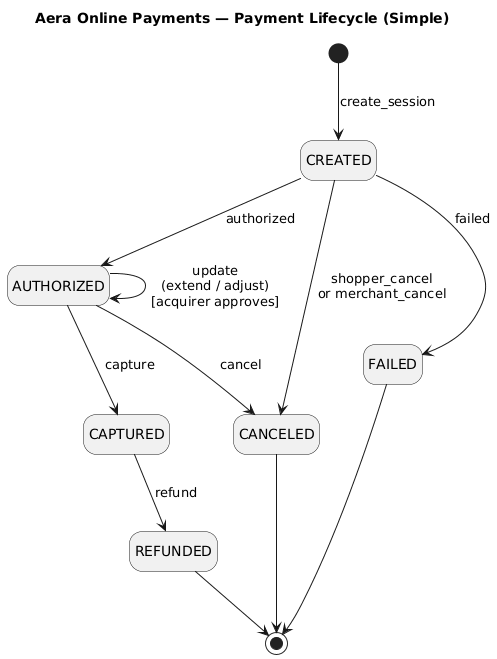
Simple
The simple state machine illustrates the core payment lifecycle:
- Creation
- Authorization
- Capture
- Cancel
- Refund
- Failure
It is intended to provide a high-level overview of the typical payment flow and is suitable for most integrations.
Complete
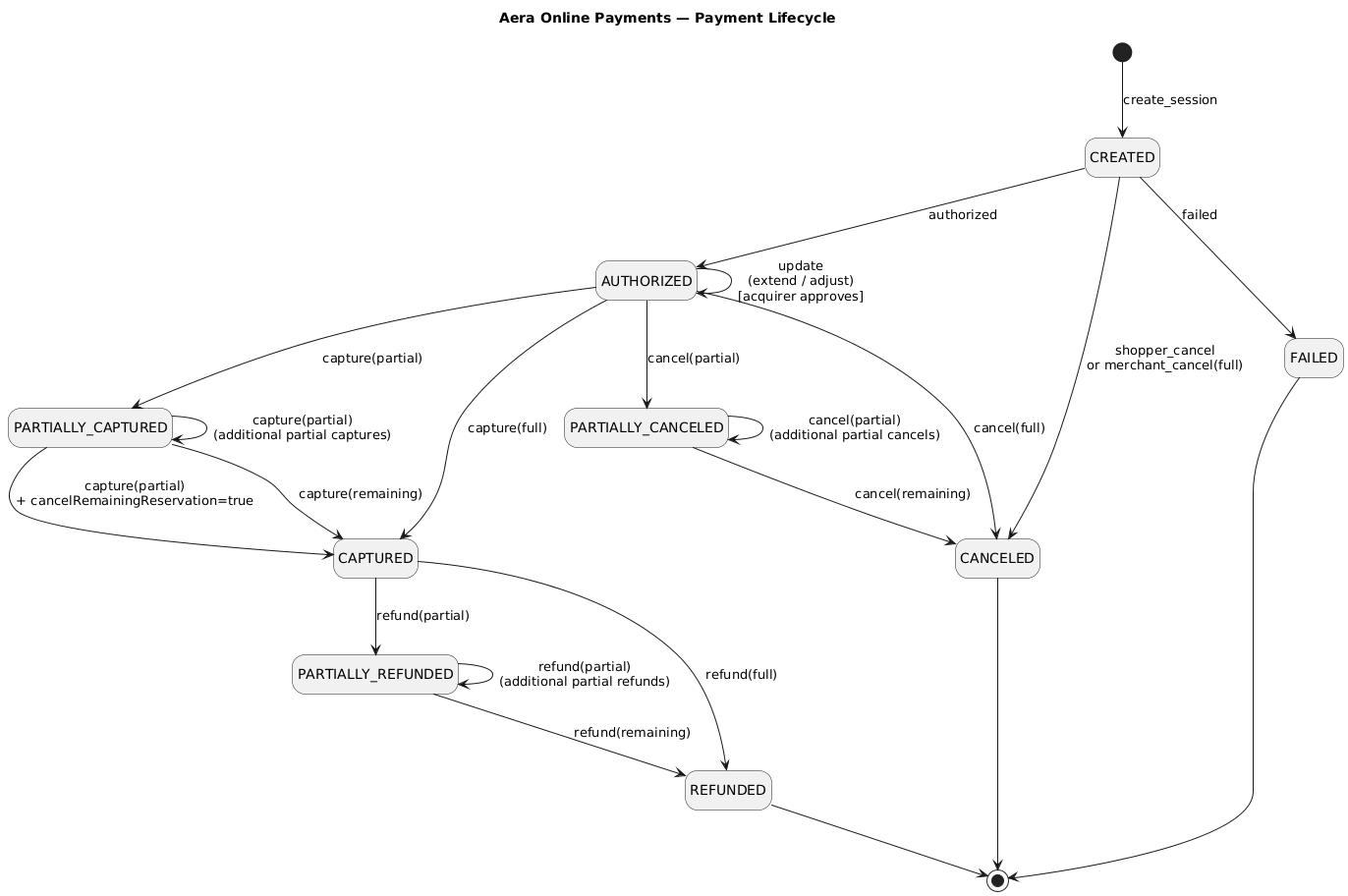
The complete state machine expands on the simple model and includes:
- Partial captures
- Multiple partial captures
- Partial cancels
- Multiple refunds
This diagram is intended for merchants that implement advanced operational flows, such as:
- Split shipments
- Order adjustments
- Omnichannel fulfillment
- Incremental reservation management
Both diagrams represent the same underlying lifecycle, with the complete version adding more granular transitions.
Updated 13 days ago